
Low-Pressure Boron Injection for Structural Oak
For structural beams where surface treatment alone cannot reach the active larvae.
When surface treatment alone won't reach the larvae
Injection treatment is the only chemical method that reaches the larvae of Deathwatch Beetle (Xestobium rufovillosum), House Longhorn Beetle (Hylotrupes bajulus) and deep-tunnelling Common Furniture Beetle inside heavy structural timber. Surface boron protects the outer 3 mm; injection drives a high-solids boron paste 20–80 mm into the heartwood where the active larvae actually live. The two methods are designed to work together.
We use it most often on the oak ridge beams of pre-1900 Leinster estate houses, the medieval lintels of merchant houses in Kilkenny City, Drogheda and Wexford Town, the king-post trusses of country churches, and the heavy pitch-pine purlins of converted mill buildings along the Barrow and the Boyne.
What's at stake in an Irish oak beam
Deathwatch Beetle is uniquely destructive because it works in oak — the very timber Irish builders historically chose for the longest-life structural members. A confirmed infestation in a ridge beam or principal rafter is a structural matter, not a cosmetic one: cross-section loss of 25 % triggers a building-control concern, and we have seen 18th-century beams where 60 % of the heartwood was honeycombed before anyone looked up.
Treating it correctly is not optional, and treating it incorrectly is expensive. We have followed bad DIY injection jobs where holes were drilled at random spacings into modern timber bonded to the original — leaving the actual infested oak untreated while the new replacement was saturated. A PCA-pattern injection grid, calibrated to the species and section, is the only approach with a published efficacy record.
A seven-step heritage injection
Every step is recorded on a beam-mapping drawing supplied with the guarantee — useful documentation for future structural surveys and sales.
- 1
Structural quote & beam mapping
Our PCA surveyor inspects every structural timber, identifies the species, and where signs of decay are present brings a chartered structural engineer to grade load-bearing capacity.
- 2
Calibrated injection grid
Each affected beam is mapped on a 150 mm grid on the underside (200 mm on the sides). The grid is recorded on a drawing supplied with your guarantee.
- 3
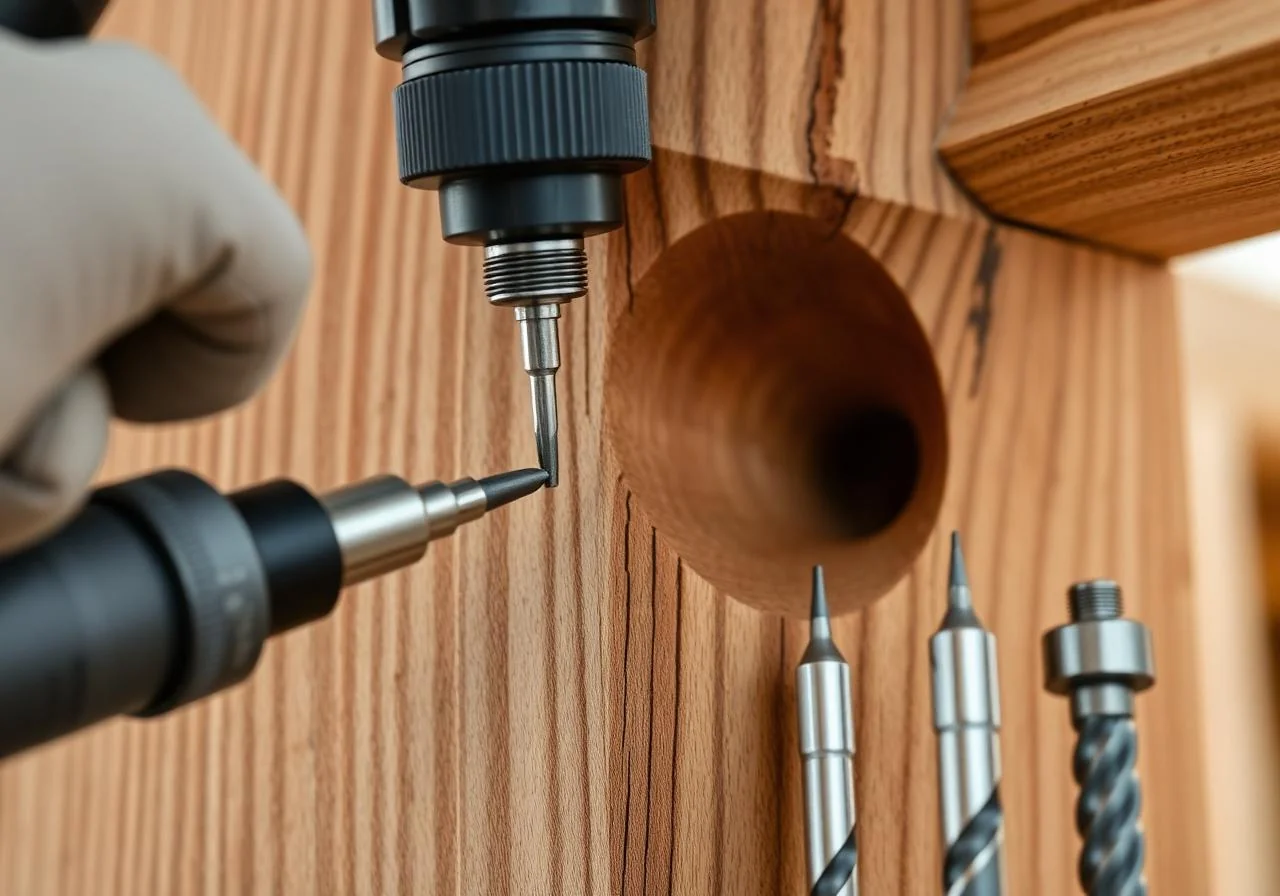
8 mm pilot holes with depth-stop
Discreet holes are drilled to two-thirds of beam depth — never further. The depth-stop ensures no exit on the opposite face.
- 4
Low-pressure paste injection
A calibrated lance delivers boron paste (≤7 bar) into each hole. The paste diffuses laterally through the heartwood over 4–8 weeks.
- 5
Colour-matched plug-and-finish
Holes are immediately plugged with matched oak, pine or elm dowels and sanded flush. Within a day the repair is invisible from normal viewing distance.
- 6
Surface boron pairing
We finish with a coat of surface boron over the same beam to prevent adult re-entry through any future flight hole.
- 7
Year-1 and year-5 re-survey
We return after the next emergence season to verify no new flight holes, and again at year 5 as part of the guarantee.
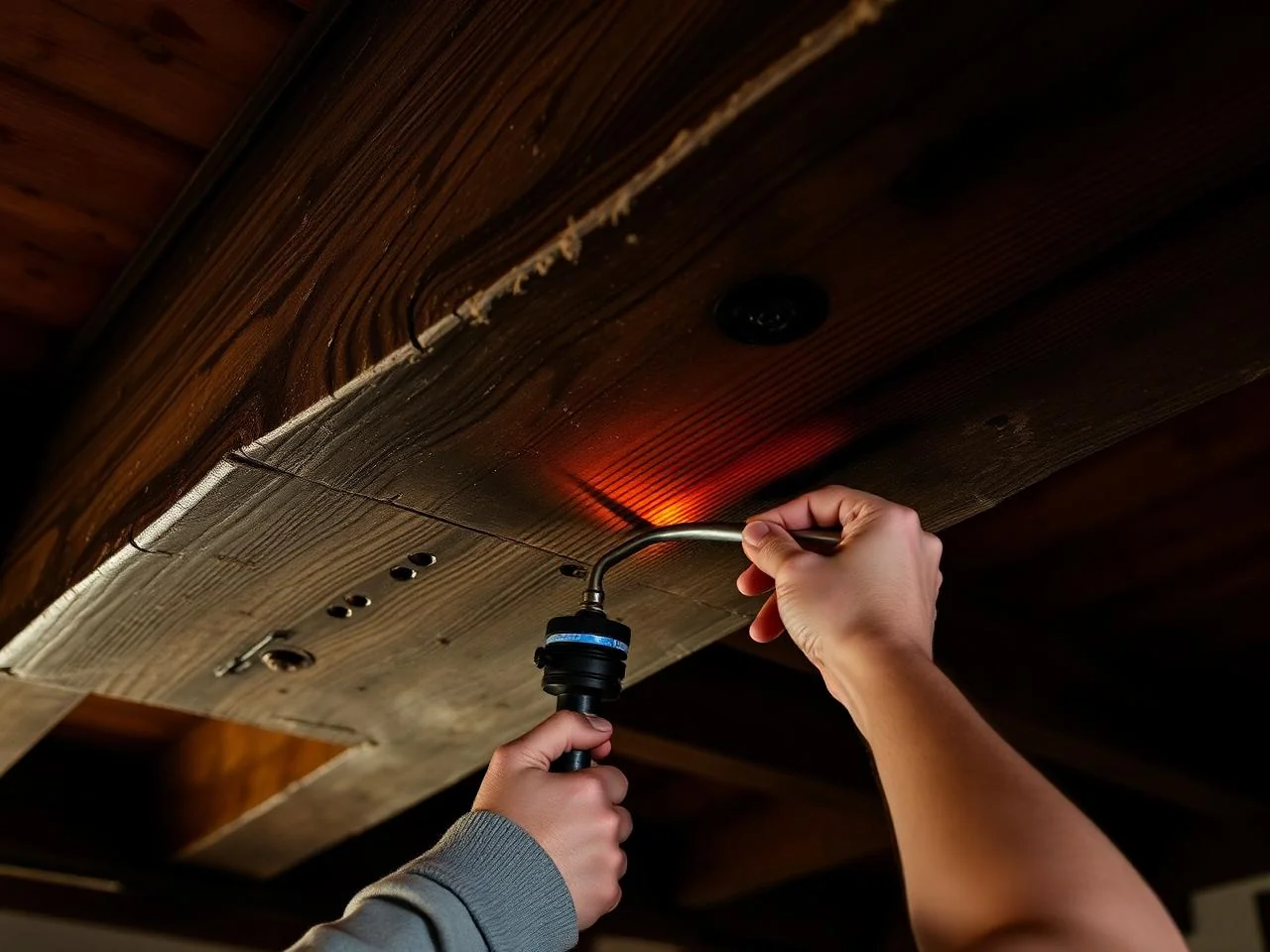
"The 8 mm holes are sanded flush within a day. From normal viewing distance the repair is invisible."
Signs you need injection, not surface treatment
Tapping from oak in April–May
Deathwatch males tap their heads against the timber as a mating call — most audible in quiet country houses after dark.
Large 3 mm flight holes
Deathwatch flight holes are larger than Common Furniture Beetle and concentrate at beam joints and end-grain.
Bun-shaped frass pellets
Distinctive lens-shaped frass — different from the fine dust of Common Furniture Beetle — gathers on floors below.
Sagging or visible deflection
Any visible drop in a structural beam suggests cross-section loss exceeding 25 % and demands urgent surveying.
Soft, spongy heartwood
An awl driven into the underside of a beam should feel firm; soft penetration indicates internal galleries.
Fungal colour change
Greyish or pinkish discolouration on oak often signals the secondary fungal decay that attracts Deathwatch in the first place.
Eight oak principal rafters, treated invisibly
The owners of a late-Georgian estate house outside Thomastown heard the distinctive April tapping in their attic for two years before calling us. Our surveyor confirmed active Deathwatch Beetle in all eight original oak principal rafters and the ridge beam. Treatment ran across four days: 1,140 injection points on a 150 mm grid, plugged with colour-matched oak dowels supplied from our own workshop, finished with two coats of clear surface boron. The conservation officer signed off without modification. The owners cannot identify a single drilled point from below.
Beam-by-beam, injection sits between €180 and €380 per linear metre of treated beam, depending on species, section and access. A typical 4-beam farmhouse treatment runs €2,800–€4,500; a country church or estate hall is usually €8,000–€18,000. Where a structural engineer's sign-off is needed (any beam with visible deflection) we include the engineer's fee in the quote — no surprise add-ons.
Why Enviroteck for injection treatment
Chartered engineer sign-off
We work with a panel of structural engineers who can certify load-bearing capacity post-treatment, useful for insurance and future sale.
Workshop-matched plug dowels
Five timber tones held in stock — light oak, weathered oak, pitch pine, Douglas fir, elm — sampled to your beams before drilling.
Heritage charter compliant
ICOMOS Ireland heritage charter compliant; documentation prepared for protected-structure consent at no extra cost.
Year-5 re-survey included
Two formal re-inspections built into the programme.
Most-requested counties for injection treatment
Also serving across Leinster
Pair injection with
Boron Surface Treatment
The first-line treatment for live Common Furniture Beetle in accessible Irish timber.
Learn more StructuralStructural Timber Replacement
When treatment alone isn't enough — sensitive heritage joinery to restore structural integrity.
Learn more RotDry Rot & Wet Rot Treatment
Eradicating Serpula lacrymans (dry rot) and Coniophora puteana (wet rot) at the source.
Learn moreTwelve answers from the surveyor's notebook
Speak to a injection treatment specialist
Free on-site quote · written quote within 48 hours · no obligation. Most enquiries are returned within one working hour.