
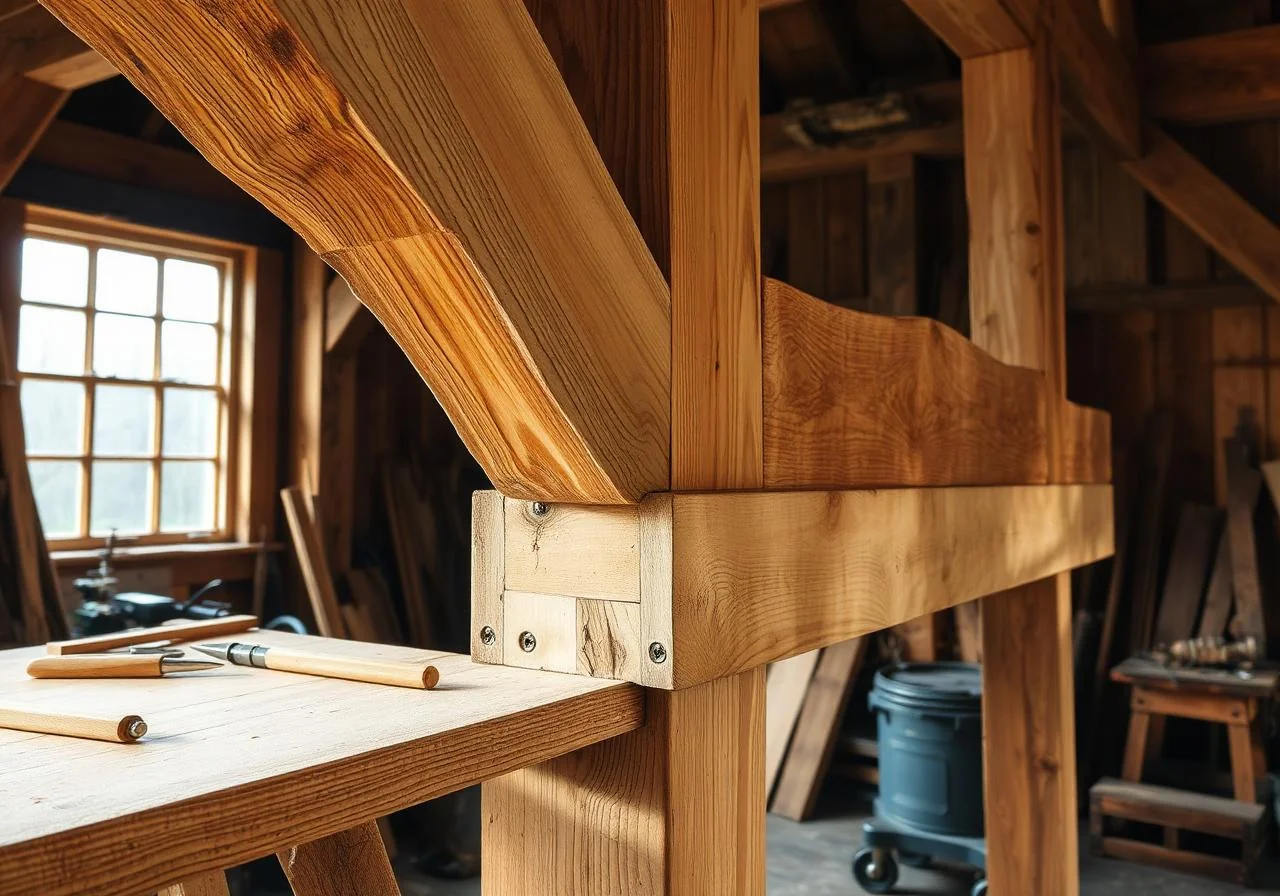
Sensitive Structural Timber Replacement
When treatment alone isn't enough — sensitive heritage joinery to restore structural integrity.
Three approaches, one principle
Preserve the original timber wherever possible. Replace only what cannot be saved. Match species, grain and profile in everything new.
Sister-joint
A new matched member fixed alongside the original beam — our default for heritage preservation.
Splice & scarf
Traditional pegged splice joints for partial replacement of localised decay.
Full like-for-like
Matched species, grain direction and chamfer profile when the beam is beyond saving.
When treatment alone is no longer enough
Structural timber replacement is what we do when treatment alone is no longer enough. Once a load-bearing beam has lost more than 25 % of its cross-sectional area to woodworm, dry rot or long-term wet rot, chemical treatment will kill the infestation but cannot restore lost structural capacity. The timber needs strengthening, and in Ireland that means heritage joinery done properly.
Our default approach is sister-jointing: a new matched member fixed alongside the original beam using traditional pegged joinery and concealed stainless steel connectors. The original timber stays in place, the structural job is done, and the heritage character is preserved. Full replacement is reserved for beams beyond saving — about one job in five.
Wrong replacement is worse than no replacement
Wrong replacement is worse than no replacement. We have followed jobs where contractors removed an original 200-year-old oak ridge beam, dropped in a glulam engineered substitute and called the project complete — only to discover the new beam transferred load unevenly into the masonry below, cracking gables that had stood untouched for two centuries.
Sensitive replacement requires three competencies working together: a structural understanding of how the original building distributes load, a joiner's eye for matched species and grain direction, and a conservation framework that satisfies the local authority's protected-structure officer. We bring all three under one roof.
When to call us instead of a chemical specialist
Visible beam deflection
Any drop visible to the eye in a structural beam indicates cross-section loss exceeding the safe limit and demands engineer assessment.
Cracking in walls above
Stair-step cracks in masonry above a beam suggest the beam is no longer carrying its share of the load.
Door or window frame distortion
Doors that suddenly stick, or windows that no longer open, often signal lintel failure above the opening.
Soft, spongy timber on probing
An awl that penetrates more than 10 mm into structural oak indicates internal decay beyond chemical treatment.
Visible rot mycelium
White cotton-wool growth or rust-coloured fruiting bodies inside a beam mean the timber's structural function is finished.
Post-leak floor sag
After a roof leak or burst pipe, joist ends embedded in wet masonry often need sister-jointing within two seasons.
From quote to handover pack
Structural quote + engineer sign-off
A PCA surveyor inspects every suspect member; where load-bearing capacity is in doubt, a chartered structural engineer signs off the calculations and the replacement spec.
Conservation officer engagement
For protected structures we prepare the Section 5 / Declaration documentation, photographs and method statement at no extra cost.
Workshop preparation
Replacement timber is selected by species, grain direction and chamfer profile to match the original, then pre-treated with boron in a workshop dip tank.
Temporary propping
Needle-propping above the beam protects the structure during the cut and lift. The original ceiling or roof finish is preserved where possible.
Joint making
Sister-jointing uses traditional pegged mortise-and-tenon or scarf joints, hidden stainless steel connectors and DPC membrane isolation at any timber-to-masonry junction.
Finish and document
New timber is hand-finished to match the original patina. Photographs, drawings and the engineer's calculations are bound into your handover pack.
Lifetime workmanship guarantee
If a joint we made fails, we return and repair it free for the lifetime of the timber. The guarantee transfers to any future owner.
Three first-floor joists sister-jointed in matched oak
A buyer's surveyor flagged severe wet rot in three first-floor joist ends embedded in a damp solid-wall gable of an 1820s townhouse on Drogheda's North Strand. The mortgage lender required remediation before drawdown. We needle-propped the floor above, cut back the rotted joist ends, prepared new matched Irish oak in our workshop (boron-dipped, scribed to the original grain), sister-jointed with pegged mortise-and-tenon joints and DPC isolation against the masonry. Engineer sign-off was issued within five working days. Total turnaround: 11 days from quote to handover.
Sister-jointing a single beam runs €1,400–€2,800 depending on access and joint complexity. A full purlin or principal-rafter replacement is €3,500–€7,500 per member. A complete first-floor joist replacement programme (typical Georgian townhouse) sits €12,000–€28,000 including the chartered engineer's fee and the conservation consent paperwork. We never quote without the structural quote first.
Why Enviroteck for structural replacement
Irish-grown oak, air-dried 24 months
We source from licensed Wicklow and Wexford estates. No imported European oak; no kiln-dried substitutes that move once installed.
Five matched timber tones held in stock
Light oak, weathered oak, pitch pine, Douglas fir, elm — sampled to your beam before cutting.
Lifetime workmanship guarantee
If the joint we made fails, we return and repair it free — for the lifetime of the timber, transferable to future owners.
Engineer + conservation officer panel
Our chartered engineer and our heritage architect are on call for every job. No external sub-contracting; no scope creep.
Most-requested counties for replacement
Also serving across Leinster
Pair replacement with
Low-Pressure Injection Treatment
For structural beams where surface treatment alone cannot reach the active larvae.
Learn more RotDry Rot & Wet Rot Treatment
Eradicating Serpula lacrymans (dry rot) and Coniophora puteana (wet rot) at the source.
Learn more DampDamp & Rising Damp Quote
Diagnosing the real cause — because most 'rising damp' isn't rising damp at all.
Learn moreTwelve answers from the carpentry studio
Speak to a replacement specialist
Free on-site quote · written quote within 48 hours · no obligation. Most enquiries are returned within one working hour.